Posts Tagged ‘Cato Sells’

Hummer’s Advantages

Thursday, January 26th, 2012

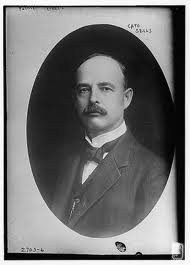
Commissioner Charles Rhoads, on left, courtesy Library of Congress

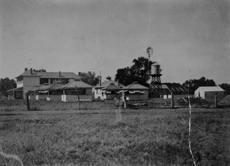
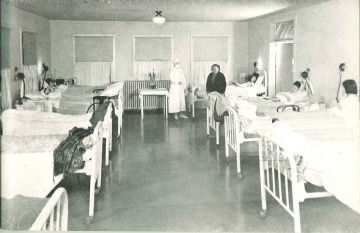
At the Canton Asylum for Insane Indians, superintendent Dr. Harry R.  Hummer was far enough away from the Commissioner of Indian Affairs to avoid direct supervision. Hummer outlasted five commissioners: Francis Leupp, Robert Valentine, Cato Sells, Charles Burke, and Charles Rhoads before commissioner John Collier threw him out of the asylum and the Indian Service.

One advantage Hummer had–as did other superintendents elsewhere–was that locals wanted the asylum to remain open and running. Insane asylums represented huge boosts to  local economies. Most towns or cities where asylums were located were quite happy about having them, and were proud of the work they did. Canton was no different. Locals enjoyed the employment and local contracts that came from the asylum and usually spoke of it quite enthusiastically.

When Hummer began to finally receive less than glowing reports, he managed to have some friends in Sioux Falls appointed as an inspection committee. They came through for him in a report to Commissioner Charles Burke early in 1929. “We went through the plant thoroughly from top to bottom and . . . found everything in first class condition.” The writer then concluded, “I consider Dr. Harry Hummer a wonderful superintendent of this institution and he has many fine employees.”

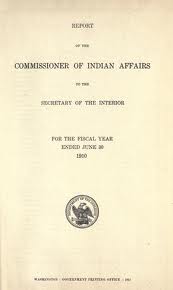
Report of the Commissioner of Indian Affairs

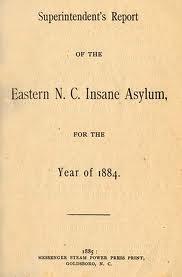
Sample Asylum Report, courtesy University of North Carolina

______________________________________________________________________________________

Who Oversees the Asylum?

Sunday, January 22nd, 2012

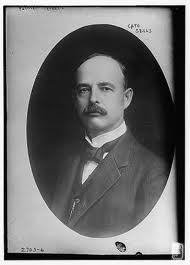
Commissioner of Indian Affairs, Cato Sells

Asylum superintendents were very powerful, but they were (theoretically) denied free rein. Most asylums had a board of directors or a board of commissioners to give oversight to the entire asylum, including the superintendent. Boards were often composed of local men who might be assumed to know what was going on, though sometimes board members had to travel from a distance to meet. Not all boards had direct hiring and firing authority, however, and could run into problems controlling or disciplining a superintendent protected by appointment.

At the Canton Asylum for Insane Indians, superintendents reported directly to the Commissioner of Indian Affairs on the other side of the country. No boards met on a regular basis to supervise the asylum, though visiting doctors within the Indian Service occasionally stopped by to inspect and report on the facility. Because they weren’t trained in psychiatry and therefore not competent to discuss patient treatment, most inspectors concentrated on the physical part of the institution, commenting more on its buildings and farming operation than anything else. Sometimes the inspectors were not even doctors, but merely field agents who happened to be in the area. Because of this situation, it was generally easy for superintendents Gifford and Hummer to explain away any problems inspectors might bring up.

______________________________________________________________________________________


Difficult to Leave

Sunday, October 16th, 2011

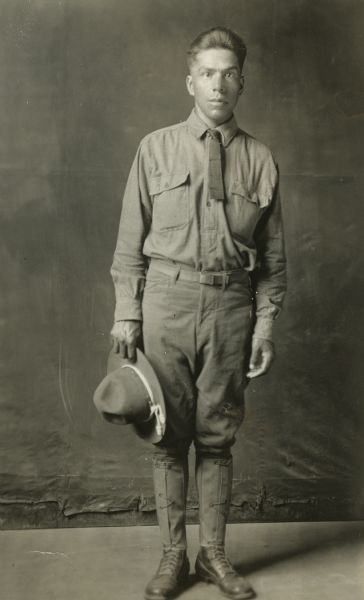
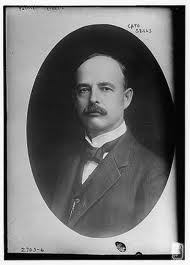
Cato Sells, Commissioner of Indian Affairs (1913-1921)

Allen Owl, a patient at the Canton Asylum for Insane Indians, demonstrates how difficult it was to convince Dr. Hummer that a patient could safely leave his care. Owl wrote to the commissioner of Indian Affairs on December 16, 1919, and ended his letter by saying: “Would be glad to get my discharge from this place. Also will obey the public & government laws from now on.”

Hummer wrote to the commissioner in reply: . . . “In other words he is about as well as he ever will be. He has a good home here, is well taken care of, is well-behaved and trusted with parole privileges of the grounds and an occasional pass to town to the picture shows. In addition to which he was permitted to work with neighboring farmers this season, earning about one hundred and fifty or sixty dollars.”

Unfortunately for Owl, Hummer added, “This, however, does not mean that he could or would do as well were he discharged and thrown upon his own resources. . . . Accordingly, I must recommend adversely to his request and hope that your Office will write him a nice letter to that effect.”

______________________________________________________________________________________


BIA Supervision

Sunday, August 14th, 2011

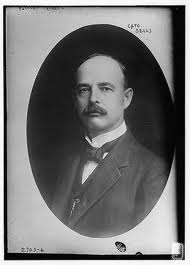
Cato Sells

The Bureau of Indian Affairs expanded over time, as many other government offices did. In its 1913 report to Congress, the Commissioner of Indian Affairs (Cato Sells) noted that the Indian Office had received 77,000 letters in 1902 and employed 132  people, but had received 209,000 letters and had employed 227 people by 1911. The commissioner presented his office in the most positive light as he highlighted the strides and failures of the past few years.

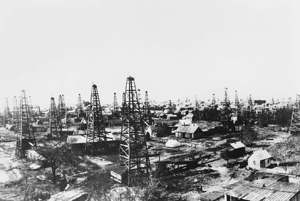
He specifically discussed the discovery of petroleum in Indian Territory. In a special report about petroleum in 1902, the Census Bureau had barely noted the existence of 13 wells there. The land was occupied by the Five Civilized Tribes, though the Secretary of the Interior had authority over it through the Curtis Act of 1898. By 1912, Oklahoma was second among oil-producing states, and pumped out almost one-fifth of all the petroleum produced in the U.S.

The wealth represented by Oklahoma’s oil consequently focused greedy attention on the Indians who were supposed to benefit from it. The next post will continue this topic.

Hoy Oil Field on Black Bear Creek near Enid, Oklahoma, circa 1917, courtesy Library of Congress

Oil Wells in Bartlesville, Oklahoma

________________________________________________________________________

Teach Your Natives Well

Sunday, August 15th, 2010
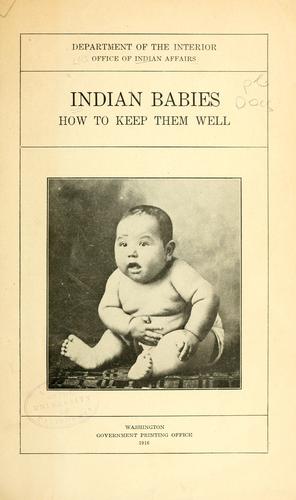
Book for Indian Mothers

Book for Indian Mothers

There was no subject at all, it seems, in which the Indian could not benefit from a little instruction. The pamphlet at the left (created by the Department of the Interior) began with a friendly letter from the commissioner of  Indian Affairs, Cato Sells.

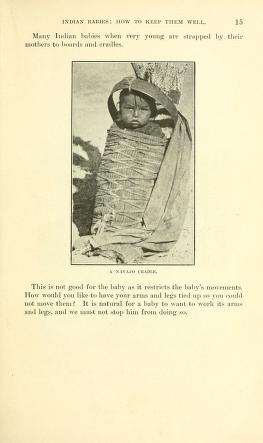
It advised Indian mothers not to feed their babies on demand, but by the clock. It also discouraged strapping babies into the traditional cradle, so they could be carried on the mother’s back.

The pamphlet did warn about serious diseases rampant within Indian communities, like smallpox and consumption. People who might be infected with consumption (TB) were advised not to swallow their spit, as it could then carry the disease to the stomach and bowel. With more practicality, it advised all Indians to get vaccinated for smallpox.

Baby in Cradle, Department of Interior pamphlet

Baby in Cradle, Department of Interior pamphlet

________________________________________________________