Posts Tagged ‘Indian service’

Who Oversees the Asylum?

Sunday, January 22nd, 2012

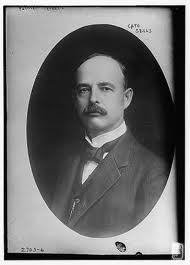
Commissioner of Indian Affairs, Cato Sells

Asylum superintendents were very powerful, but they were (theoretically) denied free rein. Most asylums had a board of directors or a board of commissioners to give oversight to the entire asylum, including the superintendent. Boards were often composed of local men who might be assumed to know what was going on, though sometimes board members had to travel from a distance to meet. Not all boards had direct hiring and firing authority, however, and could run into problems controlling or disciplining a superintendent protected by appointment.

At the Canton Asylum for Insane Indians, superintendents reported directly to the Commissioner of Indian Affairs on the other side of the country. No boards met on a regular basis to supervise the asylum, though visiting doctors within the Indian Service occasionally stopped by to inspect and report on the facility. Because they weren’t trained in psychiatry and therefore not competent to discuss patient treatment, most inspectors concentrated on the physical part of the institution, commenting more on its buildings and farming operation than anything else. Sometimes the inspectors were not even doctors, but merely field agents who happened to be in the area. Because of this situation, it was generally easy for superintendents Gifford and Hummer to explain away any problems inspectors might bring up.

______________________________________________________________________________________


A Range of Responsibilities

Sunday, February 6th, 2011
Hubert Work (center), 1928, courtesy Library of Congress

Hubert Work (center), 1928, courtesy Library of Congress

The Indian Service, or later, Bureau of Indian Affairs (BIA) fell under the department of the Interior. The Interior department had a wide range of responsibilities, including the provision of medical services for various groups under its control.

In 1927, Secretary of the Interior, Hubert Work, tried to show the range of  just the Interior’s medical services:

– It had a floating hospital on the Yukon in Alaska (a territory at the time) and supported territorial Boards of Health in Alaska and Hawaii.

– It safeguarded the health of visitors within the National Park system.

– Trained nurses and field matrons went to remote areas of the country, teaching hygiene and sanitation.

– The department’s Geological Survey investigated ground water supplies.

– Its Bureau of Education investigated the status of physical education and hygiene in colleges and reported on the health of teachers

– Through its Bureau of Pensions, conducted physical exams and medical rating boards for veterans.

The department supported more than 100 hospitals providing over 2 million days of hospital care; the Indian Bureau maintained 91 of them. More than 30,000 Indian patients were treated in these hospitals in fiscal year 1926.

BIA Health Officer

BIA Health Officer

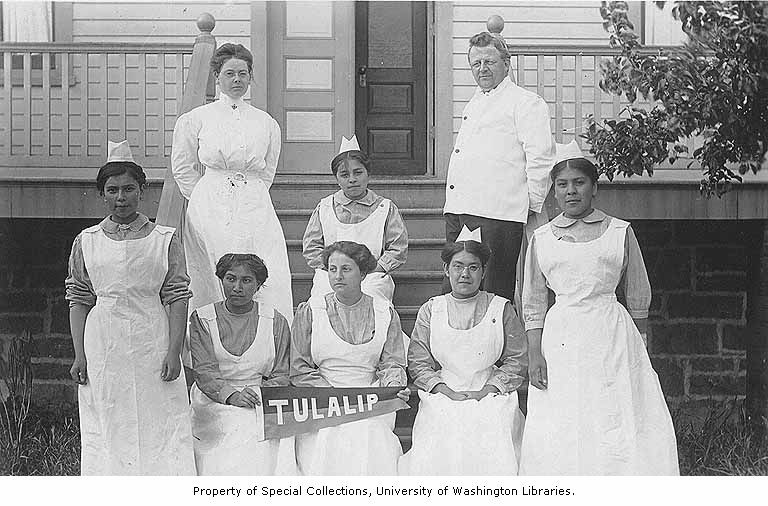
Tulalip Hospital, Tulalip Indian Reservation, 1910, courtesy Library of Congress

Tulalip Hospital, Tulalip Indian Reservation, 1910, courtesy Library of Congress

________________________________________________________

Drowning In Data–Not

Thursday, December 23rd, 2010
St. Elizabeths, N-building, courtesy Library of Congress

St. Elizabeths, N-building, courtesy Library of Congress

Senator Richard Pettigrew’s suggestion for an insane asylum just for Indians created a flurry of activity within the Indian Office. The acting commissioner of Indian Affairs, Thomas P. Smith, was certainly open to the idea. He wrote to the secretary of the interior in favor of it, saying in a (July 2, 1897) letter that the establishment of an insane asylum would materially advance the Indian service.

Furthermore, he said such an asylum would relieve the overcrowding at the Government Hospital for the Insane (St. Elizabeths). He finished his letter by saying: “Without having very much data on the subject, easy of access, to regulate its judgment, the opinion of this Office is that an asylum that would accommodate fifty patients would be ample.”

As it turned out, the Indian Service could only discover seven insane Indians, and only five of them were at St. Elizabeths.

St. Elizabeths, 1909, courtesy Library of Congress

St. Elizabeths, 1909, courtesy Library of Congress

________________________________________________________