Posts Tagged ‘alienist’

Sorrow, Vice, and Thyroids

Sunday, May 19th, 2013

Many Physicians Believed Insanity Stemmed from Physical Causes

Some of the new ideas about insanity and ways to prevent it helped doctors believe in cures after a long period in which they had resigned themselves to believing that most insanity was chronic. An article from the November 12, 1922 edition of The Washington Post quoted Dr. Toulouse, a renowned French alienist, who had founded the League for Mental Hygiene and Prophylaxis. He believed that “half the occupants of the world’s insane asylums are not mad, but diseased.” Like most other alienists, Toulouse also believed that early intervention was critical; he set up a clinic where people could go when they felt their “nerves giving way.”

Toulouse believed the three great causes of insanity were sorrow, thyroid deficiency, and vice. Patients at his clinic would be questioned at length so that Toulouse could arrive at a life history for the individual. A physical exam would then determine whether they “were born with an excess of thyroid matter” or whether they had become addicts to vice–including drugs. Though all three (main) causes of insanity could be cured, Toulouse felt that madness caused by sorrow was the most difficult to resolve successfully.

Sorrow caused by bereavement or crosses in love could be healed after time, but sorrow caused by loss of money was the hardest to cure. “Practically the only sedative for a person who has once been wealthy and who finds himself suddenly poverty-stricken is to provide him again with wealth,” said Toulouse. This was obviously an impractical course of treatment.

______________________________________________________________________________________

Advances in Healing

Sunday, May 12th, 2013

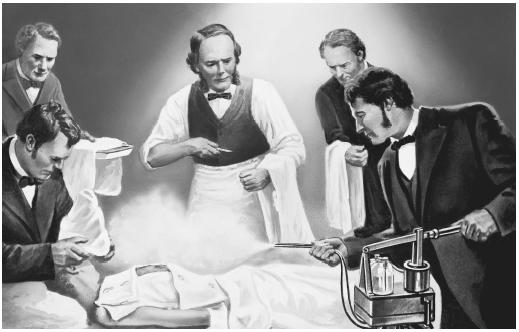
Lister's New Disinfectant Method in Use

Important medical breakthroughs occurred during the 1800s. Especially important was the idea that disinfectants could help prevent the spread of disease in hospitals. Joseph Lister used carbolic acid to clean wounds and surgical instruments in hospitals, which brought deaths from infection down from 60% to about 4%. Many doctors scoffed at his ideas, but his success forced them to adopt his methods. Just a few years later, Louis Pasteur and Robert Koch developed the germ theory of disease. This was also revolutionary, since many doctors until then had no idea whatsoever about the mechanism of disease. Some thought illness generated spontaneously, while others thought the atmosphere could contain the elements of ill health or that certain personalities and physical attributes predisposed people to certain diseases.

In 1879, researchers developed a vaccine for cholera. Before the turn of the century, vaccines were developed for anthrax, rabies, tetanus, diphtheria, typhoid, and plague. It must have seemed that science had conquered–or would soon conquer–all the ills of mankind. It was a hopeful time, which led both medical doctors and alienists (specialists in treating diseases of the mind) to believe that few conditions were beyond treatment and cure.

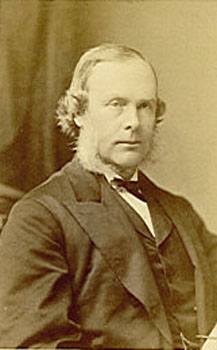
Joseph Lister

Robert Koch, courtesy National Library of Medicine

______________________________________________________________________________________

Attitude Is Everything

Sunday, February 10th, 2013

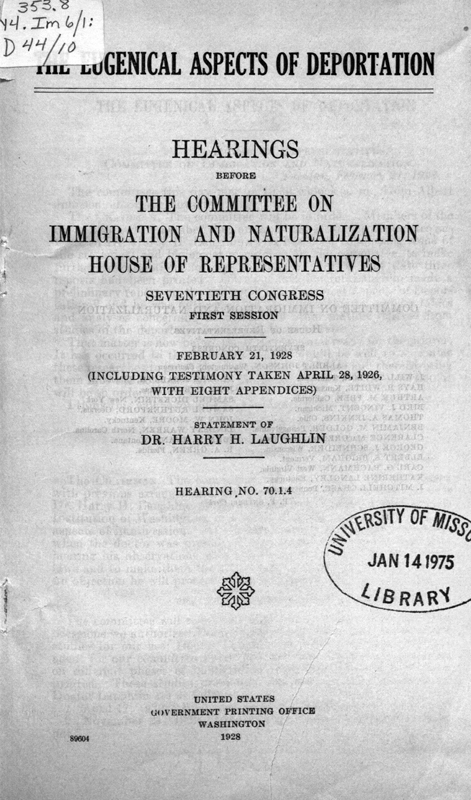
Officials Wanted to Keep Unfit People Out of the U.S., courtesy missouri.edu

Many people, both lay and professional, passionately debate the very essence of insanity. Some people believe that insanity is mainly a social construct, which can change over time as society itself changes. That is, what was once considered insane is now accepted as normal, or vice versa. Are there truly “insane” behaviors which every society, in every time period, agrees are insane? If not, how can insanity really be established if its definition changes over time?

This societal construct particularly gave trouble for those who didn’t fit mainstream society and weren’t protected by laws or tests which took culture or country into account. Early immigrants often faced criticism as they tried to integrate into American culture. Their different ways were either seen as merely odd or “foreign” and tolerated, or were actively disdained and suppressed. The real problem arose when someone with particularly odd behavior came to the attention of authorities. When the question of insanity arose, the standard that immigrants were judged against was not their own culture and what was accepted within it, but by the Anglo-based white culture in their new country. When immigrants came before an insanity commission or a typical alienist, they often did not present themselves to advantage. If the suspected lunatic could not speak English well, acted out nervousness and fear in odd ways, or refused to answer questions due to fear or confusion, he  helped build a case for his insanity.

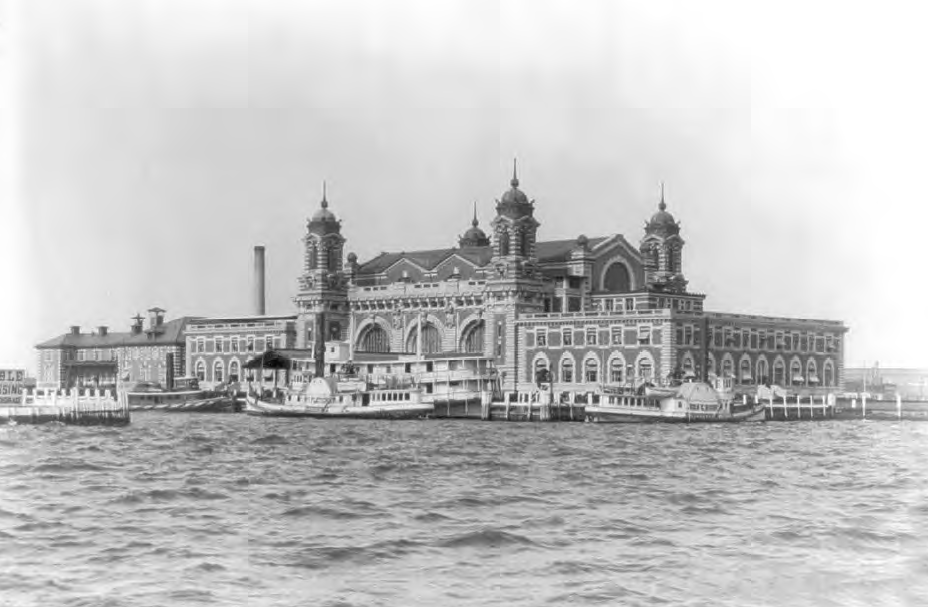
Ellis Island, courtesy Library of Congress

Immigrants Waiting Examination, courtesy Library of Congress

______________________________________________________________________________________

Putting a Name on It

Sunday, January 13th, 2013

The Hudson River State Hospital Was a Kirkbride Building

Interest in mental health and how to care for the mentally ill heightened as time went on and professionals became more immersed in studying the intricacies of the mind and human behavior. In the United States, by the turn of the twentieth century large asylums were still the tool of choice for helping the insane become well, or for dealing efficiently with the chronic insane. As mental health specialists made advances in treatment, they continued to look at ways to present themselves and their work to the public in a positive way.

In 1854, the Association of Medical Superintendents of American Asylums for the Insane (AMSAAI) debated on what terms they should use to even describe the buildings where their patients lived. Dr. Thomas Kirkbride, a pioneer in asylum architecture, presented a paper at the AMSAAI’s ninth meeting: “On the Importance of Precision and Accuracy in the Use of Terms for Insanity and Instructions for its Treatment.” In it, he objected to worlds like lunatic, asylum, retreat, keeper, and cell to describe anything within the walls of what were commonly known as insane asylums. In many people’s minds, the word “hospital” was only a place for paupers and outcasts, so it was not suitable, either. “Insanery” seemed suitable to one doctor discussing the paper, since it resembled the British word “infirmary.” This particular alienist (mental health specialist) did not especially object to the terms asylum or lunatic, since the former signified a sacred place or sanctuary, and the latter had been in common usage for a long period.

By 1920, at the seventy-sixth annual meeting of the American Medico-Psychological Association, which had incorporated the old AMSAAI, words like cell and keeper had indeed been discontinued because of their negative connotations. Now the concern at hand was whether or not to change the name of their organization and the way they referred to insanity. In the end, the organization was re-named the American Association of Psychiatrists, and the word psychiatry was substituted for the words “the treatment of insanity.”

Dr. Thomas Kirkbride and His Book on Building Asylums

Philadelphia Hospital for the Insane, circa 1900, courtesy University of Pennsylvania

______________________________________________________________________________________

Understanding Insanity

Thursday, August 23rd, 2012

Alienist Dr. Allen McLane Hamilton, 1910

Even though alienists (the term for early psychiatrists) treated insanity with vigor and resolution, they usually could not say with any certainty what had caused the condition. An 1879 article, “Early Indications of Insanity,” in The American Journal of Insanity stated that in general, the cause of all insanity could be found in the neglect of, or an infraction of, the “established laws of physical or mental health.” Since this could encompass almost anything, the writer went on to the core of his article, which was how to determine that someone was going insane.

One principle the author (Dr. Judson B. Andrews, assistant physician at the New York State Lunatic Asylum) stressed was that insanity should not be judged by arbitrary standards; instead, it should be judged by noting a change in the person under consideration. This at least allowed for individual personalities and quirks; alarm would arise only when typical behaviors for that individual changed. However, Andrews did believe that there were precursors to insanity that one could watch for. The earliest indication was morbid dreams, when there was no “definite exciting cause.” Even more important was sleep impairment. Andrews described what we might today called “racing thoughts,”  and explained how the condition left a person unrefreshed even when exhaustion permitted sleep.

Other disturbances that were precursors to insanity were: loss of appetite, indigestion (especially with pain and belching), flatulence, heartburn, constipation, and offensive breath.

New York State Lunatic Asylum, circa 1870 to 1885, stereoscopic view

Woman Diagnosed with Insanity Due to Childbirth, courtesy Bethlem Royal Hospital Archives

______________________________________________________________________________________

Pursuing an Agenda

Thursday, March 1st, 2012

American Journal of Insanity

Asylum superintendents tended to support each other and their profession, and presented a united front to the public. Though they published studies and treatment-oriented articles in the American Journal of Insanity (AJA) and other medical organs, the AJA in particular reflected much of their philosophy.

In a July, 1868 article, “Admission to Hospitals for the Insane,” the author contended that it was especially unkind to make the insane endure a public hearing on their sanity. “If we find a man sick or wounded in the street, we take him forthwith to the nearest hospital, without stopping to canvass our legal right to restrain him of his liberty,” the author stated.

With the insane, however, relatives force publicity by requiring “an inquisition to establish the delirium or the lunacy,” the article continued. He said that there was no more reason why a magistrate or civil authority should inquire into treatment [for an insane person] than there was to “rescue a patient from the hands of a skillful surgeon who is binding him to an operating table to perform an amputation.”

This article is only one instance of an ongoing disagreement between the psychiatric profession and private citizens about the value of admitting (or coercing) patients into asylums without due process.

Amariah Brigham, founder of the AJA

Mary Todd Lincoln (Judged Insane by a Jury After a 10-Minute Deliberation)

______________________________________________________________________________________

Gaining Prestige for Asylum Management

Sunday, December 11th, 2011

Bellevue Hospital, NY, 1885, courtesy Wellcome Images

One of the immediate issues facing insane asylum superintendents was their initial lack of status. The term “mad-doctor” had little to recommend it as an indication of learning and professionalism. Even the term “alienist” did not convey to the public the intricacies of helping disabled minds. To enhance their stature, these early psychiatrists found it helpful to band together in professional groups.

The American group first communicated with each other informally through letters. Then a group of thirteen insane asylum superintendents met in 1844 to share information and exchange ideas about the treatment of the insane. They named their group the Association of Medical Superintendents of American Institutions for the Insane.

German psychiatrists united as a professional body in the Association of German Mad-doctors in 1864, though the General Journal for Psychiatry and Psychic-forensic Medicine had begun publication in 1844. The British organized the Psychological Society in 1901. They changed their name to the British Psychological Society in 1906, to avoid confusion with another organization of the same name.

These early societies were successful in gaining stature for their profession. Many alienists began to testify as expert witnesses in public trials, and the public in general felt safe in relying on their judgment.

Published June 25, 1911, courtesy sundaymagazine.org

______________________________________________________________________________________