Archive for the ‘1900s newspapers’ Category

Compassionate Doctors

Thursday, March 21st, 2013

Dr. William A. White, Superintendent at St. Elizabeths, courtesy National Institutes of Health

Though many abuses toward patients  were either condoned or ignored by senior staff, some doctors cared very much about patient abuse. When Dr. William A. White took over as superintendent of St. Elizabeths (the federal government’s hospital for insane soldiers, sailors, and citizens of Washington, D.C.), he immediately issued a terse letter absolutely revoking use of the saddle (a harness fashioned around a patient in bed and tied so that he/she could not raise up) as a restraining device.

Anna Agnew (see last post) witnessed an amazing scene when a new superintendent (Dr. Fletcher) arrived at the asylum where she stayed. Fletcher banned all restraints and then went a step further. He gathered up the various devices in the asylum and made a bonfire of them in front of the patients. Fletcher’s action to abolish restraints was generally applauded, except for the spectacular way he did it. Newspapers reporting on the incident suggested that the matter might have been handled with a little less sensation, though they agreed that restraints were usually a bad idea.

Picture of Patients Under Restraint, courtesy National Institutes of Health

Utica Crib, an Early Restraining Device

______________________________________________________________________________________

Patients Not Always Coerced

Thursday, March 14th, 2013

Catharine Beecher

People who realized they were having problems coping with life often voluntarily sought cures for their mental distress. Catharine Beecher, sister of Harriet Beecher Stowe and later co-author with her of a very successful book entitled American Woman’s Home, or Principles of Domestic Science (1869), found the rigors of earning her living overly taxing. When she was twenty-three years old, Catharine supervised a school with 160 pupils, many of them boarders. After ten years of school-teaching, “the nervous fountain gave out entirely,” Beecher said. “I could neither read, write, or converse, nor even bear to hear conversation.”

Beecher traveled and consulted numerous medical men, who tried various remedies without success. She took pills, underwent galvanism (in which electrical pulses were applied to contract her muscles), visited a clairvoyant, and took the Water Cure. She was wrapped in a wet sheet “at four in the morning,” and kept in it for a few hours before being plunged into a cold bath. Then she had to walk as far as she was able, drink several glasses of cold water, stand under water falling from a height of eighteen feet, drink more water, and so on. She was wet all day.

Beecher related that she spent over ten years under various types of  medical treatment,  often returning to a mild water cure as the best restorative. She met many other women at these water cure institutions, and began to believe that American women were not as healthy as they should be. Beecher exhibited periods of extraordinary energy and productivity during her lifetime, and it could be that water cures gave her a form of “time out” to rest and assess her work. She made women’s health a great priority, and gave women common sense tips for dress and diet, as well as advice for efficiently running their homes. Unlike so many cases, Beecher’s treatments for her her mental maladies were voluntary, rather than coerced.

Pleasures of the Water Cure, 1857, courtesy National Library of Medicine

Water Cures Were Popular With Those Who Could Afford Them

______________________________________________________________________________________

Language Barriers

Thursday, February 14th, 2013

Public Health Service Staff Inspecting Immigrants. All idiots, insane persons, etc. were to be excluded from the country, courtesy National Institutes of Health

As asylums grew larger and lost their ability to integrate mentally ill or temporarily distraught citizens back into society, they became warehouses for people who could not cope with or mesh into the current culture. Most asylums assumed a custodial role, rather than a therapeutic one. Asylum superintendents noted early on that immigrants made up a larger proportion of the “insane” than native born peoples did, and usually attributed that situation to the inferiority of immigrant minds rather than to their own cultural snobbery or misconceptions (see last post).

Though it undoubtedly happened, most asylum patients who could not speak English were not simply lifted from the streets and thrown into asylums. Usually a complaint about the person’s behavior came from someone, and then further questioning would make it apparent to authorities that the person before them did not adhere to societal expectations. Many sane immigrants were caught in this net, unable to explain themselves well because they lacked language skills, or too intimidated by what they considered foreign (and formidable) authorities to defend themselves. Interpreters may or may not have been used, but considering that many white Americans went  before a sanity board without benefit of a formal defense, it is easy to believe that most immigrants stood on their own or with dubious help from others.

Native Americans who could not speak English well were also vulnerable to these kinds of abuses. A bigoted sanity board would not consider cultural differences, and language barriers would only make the Native American look ignorant or mentally deficient. If the accused lost his temper or gave in to emotional turmoil, he made himself look worse. Many patients were railroaded into insane asylums, but the most vulnerable patients were those who fell outside traditional Anglo-based American culture.

A Six-Man Jury Declared Koslowski Insane in 1911

Eloise Insane Asylum in Detroit, 1911

______________________________________________________________________________________

Case Study

Thursday, February 7th, 2013

Man With Apoplexy, courtesy National Institutes of Health, History of Medicine

Asylum doctors tried hard to share information about the developing field of psychiatry, and sometimes discussed interesting cases in journals. In the January, 1869, issue of the American Journal of Insanity, Dr. Judson Andrews gave details about a fifteen-year-old-boy brought into his asylum. The progression of his disease follows:

The boy was healthy and free of insanity until he developed typhoid fever and became delirious in April of 1868. He demonstrated mental disturbances by a change in his character, since he began stealing from neighbors’ gardens and hanging around with “evil associates.” He also became profane, was disobedient to his parents, and danced and sang comic songs. Later, he was hit in the head with a rock thrown by a comrade. The boy was admitted to the asylum that September, and gave no immediate indication of insanity. A few days later, however, he began to do odd things: wash his clothes in a bathtub, eat voraciously, and sometimes vomit food. Otherwise, he was obedient and “anxious to make himself useful.”

In November, he suddenly complained of headache and pain in his stomach, screamed, and passed into a convulsive state. On being examined, he became maniacal for about two hours and then was rational. He complained about a pain in his head, telling the staff that he felt at times “as though he had swallowed tobacco.” At four p.m., he died suddenly.

An autopsy sixteen hours later found a quantity of internal bleeding, and the doctors determined that the boy had died of apoplexy. Apoplexy originally meant any sudden death after the loss of consciousness, and usually indicated what we would call a stroke, today. Though they doctors involved acknowledged that it was unusual to see apoplexy in one so young, rather than revise the diagnosis of insanity that preceded the event, they believed, instead, that the maniacal fit had simply brought it on.

Apoplexy Was Mysterious

An Extraordinary Cure from a British Doctor, courtesy thequackdoctor.com

______________________________________________________________________________________

Character and Caricature

Thursday, January 3rd, 2013

Native Americans fought in WWI for many reasons: proof of their loyalty to America, a desire to go overseas, ties to friends and family who volunteered, a desire to fight and prove their manhood (as many young men at the time wanted to do), and for a myriad of other reasons. Though a few all-Indian units did exist within the army, military leadership at the highest levels wanted full integration. They thought integration would prepare Indians for citizenship, expose them further to white culture, and alleviate any existing racial prejudice.

War Propaganda Urging Enlistment

Native American soldiers were noted for their bravery and their presence at the front, in the thick of battle. Journalists could not resist dredging up stereotypes. The Washington Sunday Star noted that “The Aviation Corps of the Army makes an appeal to the red-skinned youth as fully as to the pale-face.” A reporter on another paper noted that an Indian woman was studying to be a radio operator and added that “Indians had once used smoke signals.” Reporters almost invariably attributed stereotypical broken speech to Indians when they quoted the exploits of particularly brave military members. After a raid, one Native American supposedly said, “Heap big noise inside” and referring to the enemy, “Perhaps heap big dead now.”

Liberty Bond campaigns (see posts on 12/13/13 and 12/16/12) often relied on the public’s stereotyped images of Native Americans. Native Americans bought Liberty Bonds in great numbers, a notable achievement considering their economic status. They contributed to these campaigns with more than their money, however. Many bond drives used Native Americans dressed in war costume to urge the public to buy bonds; at least one Native American regularly did a war dance  in public to help sell war stamps . Considering that most Native Americans during WWI were not citizens and could have been exempted from service, they responded to America’s need during the war in a remarkable way.

The Patriotic Fund Supported the Wives and Children of Enlisted Men During WWI

Registration Announcement

______________________________________________________________________________________

WWI Christmas

Sunday, December 23rd, 2012

Photograph of Truce Participants

WWI (1914-1918) led to the death or wounding of 25 million people. It was the first true intercontinental conflict and introduced other firsts to the world of warfare: large-scale mechanical and chemical weapons and the aerial bombing of both soldiers and civilians, among other tragic innovations. Slaughter is a word long associated with the massive death toll among the men stuck in miles of unmoving trenches.

On Christmas Eve in 1914, German soldiers in Ypres, Belgium, began singing Christmas carols and lighting small Christmas trees. As Christmas Day dawned, Germans called out to their British enemies not to shoot them, as they approached their trenches. The British feared a trick, but seeing that the Germans were unarmed, climbed out of their own trenches. The enemy combatants shook hands, exchanged cigarettes, sweets, and other small luxuries, and quickly established an informal truce. The truce manifested in similar ways up and down a great portion of the trench lines on the Western Front: hesitant men shouted greetings, sang songs, and lobbed gifts at each other, before eventually setting aside their fears and differences to meet face to face. Some places relaxed enough to play an informal game of soccer. The truce primarily engaged British and German troops; it appeared to be widespread, though not total. Both sides took advantage of the peaceful hours to recover and bury the dead that lay in No-Man’s land.

Though participants wrote home about the truce with wonder and delight, officers and even many soldiers on both sides were horrified by the cessation of hostilities. They made sure it didn’t happen again, but it remained a treasured memory for those who enjoyed that strange, brief period of peace.

Royal Dublin Fusiliers With German Soldiers on Boxing Day 1914, courtesy Imperial War Museums

No-Man's Land

______________________________________________________________________________________

The Nation at War

Sunday, December 16th, 2012

Decoded Zimmermann Telegram, courtesy National Archives

In the early 20th century, Americans tended to be isolationists when it came to foreign policy. For the most part, WWI looked like a European conflict into which America need not enter, and president Woodrow Wilson pledged to keep the country out of the conflict. However, after Germany continued to attack unarmed merchant and passenger ships the U.S. severed diplomatic ties with it. In January 1917, British cryptographers deciphered a communication between German Foreign Minister Arthur Zimmermann to the German Minister to Mexico. In it, Zimmermann offered United States territory to Mexico in return for joining the German cause. Britain shared the telegram with Wilson, and U.S. papers published it in March. On April 6, 1917, Congress formally declared war on Germany (and its allies).

Public opinion about the war underwent a great change from its previous neutrality. Everyone was expected to help win the war. Women worked on the home front by serving meals that spared essential foodstuffs like grain, ran their households as frugally as possible, and filled in for men who left home for the military. Men found it very difficult to resist the call to arms. And, just as Native Americans joined campaigns to buy Liberty Bonds (see last post), they supported the war effort by entering the military. My next post will discuss this topic further.

Sailors Peeling Potatoes at Naval Training Camp, Seattle, circa 1918

Twenty-five Hundred New Arrivals at Fort Slocum, New York

______________________________________________________________________________________

Staying Afloat

Sunday, December 2nd, 2012

Farmer's Rally Against Foreclosure in Minnesota, 1933, courtesy Minnesota Historical Society

The Great Depression affected all regions of the country, so it’s understandable that townspeople in Canton would fight to keep open any institution that gave employment to its citizens. (See last post.) Townspeople and civic leaders had a history of supporting and encouraging all their local businesses, and some were surprisingly successful even through the dire economic times of the Depression.

In 1912, entrepreneurs erected a scaffold and ski jump east of Canton, which allowed skiers to zoom down a peak for an eighth of a mile at 100 miles per hour. The site was used to host ski tournaments every couple of years (except during the Great War), and became very popular. Canton saw 5,000 attendees in 1925, 10,000 in 1927, and between 15 and 20,000 attendees in 1932–even after the bottom had dropped out of the economy. Most people would not likely spend a lot of money attending these tournaments, but businesses which could provide anything attendees needed would benefit financially from the sheer mass of customers.

A 1929 advertisement urging travelers to “Stop at Canton So. Dak.” featured the Sioux Valley Ski Tournament held in Canton and extolled the attractions of South Dakota in general and Canton in particular. Along with a photo of “The World’s Finest Ski Hill” were two photos of the Canton Asylum for Insane Indians, “The Only Institution of its Kind in the World.” Though the asylum certainly was not a pleasure spot, it was a tourist attraction. People visiting relatives in Canton or passing through often visited the asylum, which was open to interested sightseers. Again, revenue from these visitors probably didn’t have a great impact on the town, but various merchants sold postcards and souvenirs of the asylum to tourists.

Souvenir Plate of the Canton Asylum

Souvenir Spoon from the Canton Asylum

______________________________________________________________________________________

Duking it Out

Sunday, November 25th, 2012

Few townspeople liked Dr. Harry Hummer when he first came to Canton, primarily because he was replacing the very popular former superintendent of the Canton Asylum for Insane Indians, Oscar Gifford. However, Hummer eventually began to fit in and the Canton community stood shoulder-to-shoulder with him when the asylum was threatened with closure. On September 28, 1933, the front page of The Sioux Valley News proclaimed that Sunday would mark the 25th anniversary of Hummer’s stewardship at the asylum. The paper also mentioned the community’s hope that he would continue in place, along with the asylum, in order that he and his wife could “remain active and interested residents in the promotion and welfare of Canton and Lincoln county and the state of South Dakota.” No mention was made of the asylum’s Indian patients.

John Collier, Commissioner of Indian Affairs (1933-1945)

The newspaper’s real interest and concern become especially clear on another page of that same issue, where it discusses the “first four rounds in the Indian battle of John Collier et. al vs. G. J. Moen, et. al.” The first round came when “Collier darted from his corner in a surprise attack and led with a right to the jaw calling in the Indians to Washington.” The second round found his opponents securing a ten-day stay. Moen went to Washington, D.C. in the third round, and “jabbed in another five days stay which busted up Collier’s plan of attack.” Before Collier could recover from these blows, said the paper, “Moen slipped in a haymaker to the jaw in the form of a federal court injunction, which tied Collier’s hands, sent him rocking on his heels and left him gasping for breath, amid the cheers from the local gallery.”

The paper concluded triumphantly that, “After all this fracus, we’ll bet John Collier got out his map and looked to see whether Canton was in South Dakota or South Dakota in Canton.”

Mall and Capitol Building, 1933

Blackfeet Teepees, Summit of Logan Pass, Mount Reynolds in 1933, courtesy National Park Service

______________________________________________________________________________________


Always Positive

Sunday, November 18th, 2012

Panoramic View of Canton, SD, 1907, courtesy Library of Congress

The Sioux Valley News, Canton’s weekly newspaper, was unrelentingly upbeat about Canton and its prize establishments. When the Canton Asylum for Insane Indians faced closure after two serious investigations, the newspaper decried all attempts to shut the facility down and rallied to the asylum’s cause. In the September 28, 1933 issue, a front page story almost crowed about the success of legal blocks to the proposed closure,  which had been instigated by locals. Seven attendants from St. Elizabeths Hospital, the federal government’s other (and much larger)  insane asylum in Washington, DC, had come to Canton to remove Indian patients as part of the closure process. A legal injunction prevented them from doing so, and they returned to Washington without their patients.

Not content with its public delight in seeing the closure blocked, the newspaper also wanted to make sure readers knew how pleasantly surprised the Easterners had been with Canton. “They were surprised to find that everybody out here didn’t wear ten gallon hats, carry six shooters and ride cow ponies,” the paper reported. Instead, after talking with townspeople and making an auto tour of Canton and the surrounding area, the visitors “decided that this wasn’t a forgotten race out here at all.” According to the paper, the attendants found the community looking prosperous compared to the poverty in the east. One attendant even told the newspaper that he was impressed by the cordiality of the townspeople and that he wished he had a job there.

All in all, the paper wrote jubilantly, the seven attendants got the impression that “Canton is a darn nice little town.”

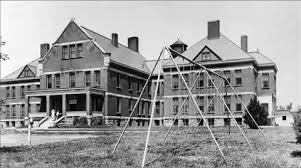
Hagan Hall, St. Elizabeths Hospital, Washington DC, courtesy Library of Congress

Chemistry Laboratory at St. Elizabeths, 1910?, courtesy National Institutes of Health

______________________________________________________________________________________